14 August 2007

KLEMS-1

Productive Factors in DGE Economics

In economics classes and the vast majority of monographs I've read on recent economic theory, it's common to refer to two factors of production: capital (K) and labor (L). In the late 19th century, this was very important since there was a lot of polemics over the correct theory of value, with the conservatives of the day insisting on the utility theory of value. Much more recently, we have seen the Solow-Swan Classical Growth Theory, in which the Keynesian theories of the business cycle were supplemented with, then replaced by, a comprehensive model of capital and technology (A) accumulation.

This has typically been disappointing to me precisely because it seemed to me that a model of the economy in which there was a single universal production function Y = f(A, K, L) would yield only certain results. Bear in mind that we're always interested in output per worker (Y/L, or y), which is always assumed to be a function of capital per worker (K/L, or k). Some modern theories of economic growth are described as exogenous, such as Solow's; they are "exogenous" in the sense that they believe the main determinant of economic growth, A, is something outside of the economic model. "Endogenous growth theory," in contrast, focuses on the tendency of capital accumulation to cause A directly. Both theories ran into serious problems with respect to international comparisons. Exogenous growth implied that the difference between countries was the result of capital accumulation, but capital accumulation in the richest nations of the OECD is actually not much larger than that of low-income countries such as the Philippines or India. Nor was this an anomaly of the present day; today, of course, saving and investment in the least-developed countries (LDC's) surpasses that of, say, the USA (where net saving is negative).

Conversely, endogenous growth theory merely consisted of assuring us that there were increasing returns to scale of capital investment; by allowing any exponent on capital that would fit the data, the endogenous growth theorists came up with the most Panglossian view imaginable of economic development. They suffered from the logical dilemma that small, island nations like Singapore often responded better to capital accumulation than large, integrated regions (like Western Europe). While Western Europe, taken as a unit, is very affluent, and K is huge, its network spillovers ought to be larger than Singapore's. As everyone knows, the opposite is true; not only that, but investors in Europe and Japan are keen on exporting capital as if they—i.e., "the market" for investment opportunities—knew better.

Also, I was well aware that some dissident economists had objected to the obsession with human inputs to the industrial economy. Labor is superabundant; economists are usually expected to make sure the supply of that is utilized. Capital is always treated as a component of prior output, or,
K = ∑(Yt-i - Ct-i)(1 - δ)i, for i = 1 --> ∞.
In the equation above, δ is the rate of capital depreciation; in each year of the past t - i, output was Yt-i and consumption was Ct-i; so ∆Kt-i is always the difference between the two, and it will hereafter depreciate at (1 - δ)i where i is how many years ago ∆Kt-i occurred. While i may be as large as ∞, (1 - δ)i would make any capital accumulated before 1968 worth about 1% of its real value in '68.

A problem, though, is that this implies that nothing bad can happen to the economy, provided the immense stock of capital survives (and the world population doesn't shrink). What about peak oil? What about significant changes in climate that reduce farm output? And, for workers, what about corner solutions in which the full employment of all non-labor resources (renewables, energy, and capital) leaves much labor unemployed?

(Part 2)

ADDITIONAL READING & SOURCES: Susan Houseman "Outsourcing, Offshoring, and Productivity Measurement in Manufacturing" (PDF), Upjohn Institute Staff Working Paper No. 06-130 (June 2006); Harold Cole & Lee Ohanian, "The Great Depression in the United States from a Neoclassical Perspective" (PDF), Federal Reserve Bank of Minneapolis (1999);

On the labor theory of value: Albert C. Whitaker, "History and Criticism of the Labor Theory of Value in English Political Economy" (PDF) Stanford University (1904); for an introduction to the utility theory of value, I have to recommend William Stanley Jevons, The Theory of Political Economy (5th edition), IV (complete text). As you can see, Whitaker's work of 1904 was a piece of historical research; Jevons introduced the alternative "utility theory" in 1870. The whole issue of value theory is hence pretty antiquarian. Or so you'd think; but Joseph A. Schumpeter, in his History of Economic Analysis, III.6.2, seems to think it's the basis of any system of economic analysis. Polemically, it means a lot to him, although he argues that one should not draw any polemical conclusions from any theory of value!

Schumpeter is correct when he says one ought not to draw any polemical conclusions from one's theory of value; but the logical corollary is that one therefore ought to use theories of values like domain-specific programming languages, a proposition that would no doubt cause Schumpeter to turn several different shades of magenta.

Labels: , ,

27 February 2007

The Rational Expectations Hypothesis (REH)

The Rational Expectations Hypothesis (REH) emerged in the early 1960's as a set of theories about the financial markets. At that time, the prevailing economic theory was Keynesianism, which had evolved massively since 1936 without much supervision from its namesake. The crucial departure of Keynesianism can be summarized as "imperfect markets," which meant,
  • prices may "never" adjust to reflect the intersection of supply & demand;
  • money is not neutral (i.e., disinflation or deflation has a serious impact on economic conditions; the available money supply, accompanied by a distinct market for cash balances, has an impact on real output);
  • factor markets, such as for labor, land, and capital, may sometimes not clear;
  • state intervention may sometimes cause more good than harm.
The last proposition is a bit difficult for some people to understand. Keynes had sought to establish a macroeconomic role for the state precisely so it could avoid a microeconomic (i.e., socialistic) one, and he attempted to establish clear, immutable boundaries for the state under conditions of economic emergency.

In the period 1946-1980, economists influenced by Keynes' system (and more decisively, by his apostles) devised a framework of economic research and policy methods that bypassed any assumption of an equilibrium. There was understood to exist a microeconomic realm, which included transactions among many buyers and sellers—and which was subject to familiar Neoclassical laws of economics—and there was the macroeconomic realm of inflation, interest rates, and factor employment, where a different set of laws applied. The chief divergence in this realm was that the market never completed its process of adjustment; it could easily stop "adjusting" to full-employment equilibrium without ever getting close.

The key objection to this was always in the financial markets, i.e., the markets for bonds, commercial paper, foreign exchange, or money equivalents. Specifically, Keynesianism models developed for government agencies tended to rely on assumptions of how the money markets would respond to government actions. Everyone reading this is no doubt accustomed to news reports of the Fed changing interest rates; but it's long been noted that the Fed has limited effect in that regard. Basically, if the administration is running a "structural deficit" and the national debt is expected to remain on a permanent upward trajectory, then a reduction in the federal funds rate (the shortest-term and lowest interest rate of all) will very likely lead to an increase in longer-term rates. This was interpreted as evidence that investors make purposeful, and therefore, rational, decisions.

From there, the REH evolved to encompass a greater scope of economic behavior. After all, money markets merely respond to professionally anticipated demand for money or credit. The real sector of the economy, the part that actually does stuff, also makes plans based on inflationary expectations. At this point, the departure from pre-1979 macroeconomics becomes a little more vivid. Whereas, Keynesian economics uses simple charts to map the entire economy (IS-LM; AS-AD), REH models abandoned such visually appealing charts. Instead of graphs linking liquidity preference to interest rates and real output (the LM curve), post-Keynesian analysis relies on modeling the utility-maximizing behavior of a representative individual through time, given certain limiting assumptions: savings occurs at the expense of consumption; labor occurs at the expense of leisure; taxation influences economic activity, and most importantly, strategies to save and work are guided by expectations of the future.

The behavior of an agent in response to economic conditions is represented as a mathematical equation, nearly always the Ramsey-Cass-Koopmans Model. The RCK model is pretty flexible, and any student can edit its objective or constraint functions to reflect new hypotheses. The purpose of doing so is to create a precise map of what happens when something happens to the prevailing conditions: a change in interest rates, a scheme of fiscal stimulus (deficit spending), or central bank interventions. The RCK model is the backbone of dynamic general equilibrium (DGE) schools of economic thought, which incorporate varying degrees of REH.

However, it is not correct to claim that all this was alien to Keynesian economics. The RCK model clearly evolved in the employ of David Cass (1965) and Tjalling Koopmans (1965), both of whom were addressing questions of long-term economic growth. Neither were concerned with fiscal or monetary policy; however, it is true that by assuming economic growth was, in effect, a function of capital accumulation, both were certainly reverting to a world in which aggregate demand was not an issue. Keynes himself devoted a chapter of the General Theory to the role of expectation in business cycles. But he did not consider expectations to be so sensitive as to respond reliably to plausible state policies, and so his exposition deals exclusively with the role of the business cycle. Not surprisingly, whereas REH tended to think expectations were something business planners used to combat the state (the "policy ineffectiveness propositions"), Keynes saw expectations as undermining the neoclassical assumptions of a self-correcting economy. Hence, Keynes' use of [adaptive] expectations tended to support the idea of fiscal and monetary policy, in contrast to the REH's school's position that [rational] expectations make both pointless.

Because REH assumptions could be adjusted within the DGE schema, economists have been free to tweak them to fit the available data. However, there have been grave shortcomings in the REH results. First, the REH predictions are especially resistant to falsification. The problem is that the algorithm for selecting coefficients on any RCK equation are determined from the historical data one is trying to fit. In my opinion, this is mere data mining. It's an adaptation of the statistical procedure called regression analysis, except that the procedure is also supposed to identify "technology shocks," or disruptive events that cause spikes in the steady growth of the economy.

Let's consider these technology shocks: a contentious matter in the early days of REH, skeptics asked for examples of them. REH proponents appealed to the principle of positive economics, arguing that the point was that their model explained what actually occurred, so technology shocks were merely stylized facts. But surely there would have been a body of literature on these all-important nodes in history, particularly as REH models tended toward a standard set of assumptions. Since no such equilibrium has occurred, each version of REH produces a different set of technology shocks. One could reasonably have expected the luminaries of the field to furnish a list of the greatest shocks, and some discussion of how they affected existing technology. Instead, the official story remains the same: it's a stylized fact, don't look at it.

Stylized facts are an understandable shorthand, but when they are constantly edited so the theory fits the observations, they don't converge to a stable version of reality. Instead, they lurch about every time the data set is increased, as with the passage of time. For this reason, I would have to say that I don't expect REH to perform better in a Bretton Woods-style crisis than Keynesianism did.


Structural Deficit: given a fixed tax code, fixed entitlement policies, and a roughly stable rate of direct government purchases of goods & services (G), a recession will cause tax revenues to fall and government expenditures to rise. This creates a deficit (or reduces the surplus, if there was one). Conversely, if the economy is in recovery, tax revenues rise and expenditures fall, causing the budget deficit to shrink or even move to a surplus.

An incoming administration has no control over the business cycle, and has little (if any) control over the duration of its tenure. Rhetoric aside, changes to the tax code or favorable trade agreements have effects over only long periods of time. So an administration that comes to office at the beginning of a recession may defend its deficit spending by pointing out that the state is structurally in balance; i.e., the inevitable recovery will bring with it a return to fiscal balance. The point is not trivial; if the deficit is structural, then money markets will have to assume that the state's growing debts will lead both to a higher demand for credit, and higher tax rates further off in the future.

Those interested in the so-called "Ricardian Equivalence Hypothesis" of Robert Barro, please note that one study of the historical evidence established a split between the structural and non-structural elements of deficits: non-structural deficits don't stimulate increased saving.

Stylized facts: a presentation of an empirical finding, usually in statistical format. An example is the result of a regression analysis, which might correlate many variables with GDP growth. One of the variables could be a dummy variable for "Protestant majority," which might have a positive coefficient; the stylized fact here is, "there's some favorable impact on economic growth from having a Protestant majority." But it's not a universally valid generalization; it depends on what explanatory variables one used, and what the data set was. Unless the data set is relevant to the conclusions one hopes to draw, it's not useful information.

When a regression analysis is done well, it will produce a set of stylized facts that, while individually inconsequential, can be used as a group to produce valid inferences. One of the arguments used by REH theorists is that, sure, their assumptions may be individually absurd, but as a rich system of equations, they are powerful analytical tools that produce useful results. Hence, a point-by-point rebuttal of REH assumptions is an exercise in futility.


ADDITIONAL SOURCES & READING:
BOOKS: Roger Guesnerie, Assessing Rational Expectations, MIT Press (2001); Stephen M. Sheffrin, Rational Expectations, 2nd Edition, Cambridge (1996); Preston Miller (editor), The Rational Expectations Revolution, MIT Press (1996);

Labels: , , ,

07 January 2007

The Dynamics of Industrial Choice (2)

(Part 1)

Industries make decisions about the implementation of technologies according to expected returns of that implementation: that's the standard position of orthodox economic theory. The reality is more complex, but it's interesting to see how even the very simple, reductionist mathematical models used to simulate the behavior of a simple economy lead to complex systems.

Since the basic rules of economic explanation are relatively simple, efforts have been made many times to reduce these to mathematical formulas that can describe the workings of a system. One idea has been to use these to re-create the laws of motion that prevail in an economy, so that the rules can be refined based on their predictive powers. The best-known attempt to do this has been the Ramsey-Cass-Koopmans Model, which simplifies the job by treating the economy as if it consisted of a single, average household.

The RAMSEY-CASS-KOOPMANS MODEL
Attributes of the household are inherent in the economic system. Households have endowments of labor (l) and capital (k). Labor is paid at wage w and capital commands an interest rate r. Hence, the income (y) of the household will be

y = wl + rk.
However, while the endowment k accrues interest without labor, it also depreciates at rate δ; presumably r < δ, or else there would be little point in holding k. Likewise, L is accumulated from y - c; in the RCK model, all income that is not immediately consumed is saved, and therefore invested in the form of more k.

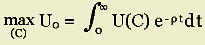
In economics, K always represents the total stock of capital; k (small) represents the supply available to our sample household at any moment in time. The symbol ρ stands for the discounting of future consumption; economists assume that consumers value future consumption less than present consumption.1 Stocks of capital depreciate at a rate of δ, so they must be replaced at a rate of δk. There must also be a rate of return on capital, which is r; it's common to assume that r = ρ + δ, since (by definition) if r < ρ + δ, people would be irrationally postponing consumption, and if r < ρ + δ, people are irrationally improvident. Each household is intuitively driven to maximize the equation below.
This is not as far fetched as it might seem. That's because the "average" path taken by millions of households groping towards an optimal allocation may well fit this description. Groping comes in the form of endless brushes with frustration and lost opportunities. Errors or eccentric decisions made by this or that individual may be expected to average out over very large numbers and over great lengths of time.

The household stock of capital increases at rate , which will be
= (r – δ)k + wl - c

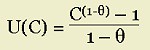
There is a consumption function U(C) is assumed to take the form below:

This is the function for constant relative risk aversion (CRRA); it is also known as the continuous intertemporal elasticity of substitution (CIES) function. Since we do not impose a time horizon, there's a risk of what is called a "corner solution," which is where the maximum point of a function lies at one limit or the other of its domain. The danger here is that the solution would be "c = 0" for all t < ∞, since ∞ is the biggest number we have. At the end of time, k∞ would be extremely large, but the who affair would be utterly pointless since our whole effort to simulate the economy with an average household would lead to that household acting in accordance with totally arbitrary equations. Such a scenario is unreasonable; people have to consume something even when their incomes are so low they can save scarcely anything, so we have limits to the value of infinitely postponed consumption.

The economy also incorporates an average firm, which transforms l and k into y. Beyond this, however, the firm does not appear; it does not have an objective function to maximize, for instance; it is not in conflict with other firms or the representative household. The RCK is an extremely adaptive model, however, and a very large number of variations on it exist. Here, we'll be sticking to the plain vanilla version.


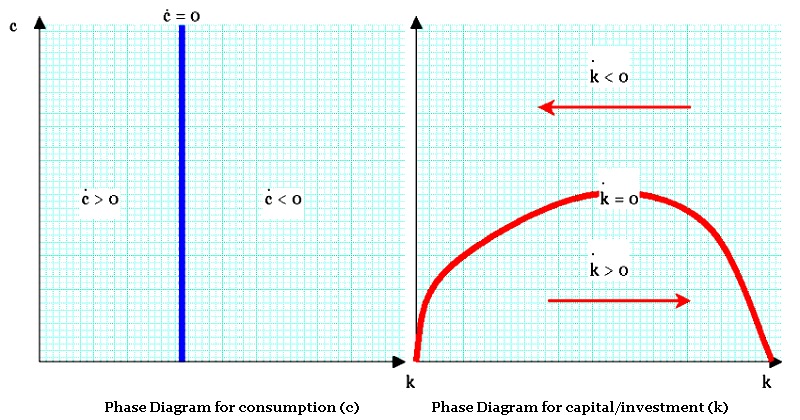
Click for larger image


This chart shows the two phase diagrams in the RCK model. On the left, the blue line represents constant, stable rates of consumption; c-dot represents the 1st derivative of c(t) with respect to time. Let's say that k* represents the point on the horizontal axis where c-dot = 0 (where the blue line touches the bottom edge). Then levels of capital endowment k* leads to a decrease in consumption.

(Please note that c-dot is instantaneous. I point this out because, if one occupies a position {k0, c0} , then one will presently move to another point on the phase diagram.)

On the right, the red curve indicates all the positions where k-dot is 0; if one occupies positions along that line, one's net growth in capital endowments is zero. For values of c above the red line, one's rate of capital accumulation is negative (one is spending out of one's substance!). For levels of c below the red line, one's rate of capital accumulation is positive, because one is consuming so little.


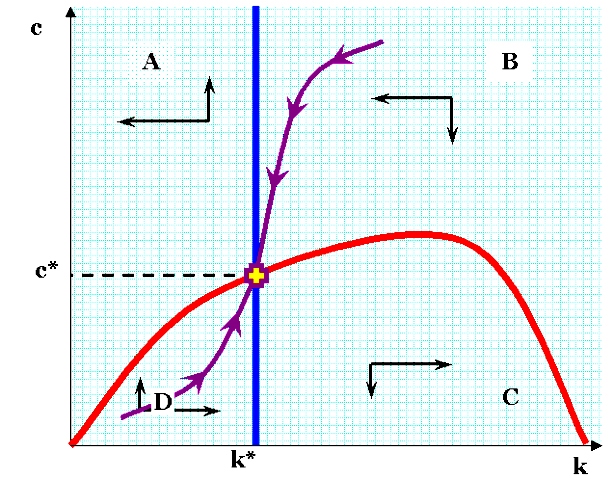
Click for larger image

Here, the two maximization functions are combined. Where the red and blue lines intersect, there is steady state consumption and capital endowment. At points along the violet line passing through the intersection, points are not in equilibrium, but are "gravitating" towards it.

The economy (in the avatar of its representative households) is has a peculiar version of the knife-edged equilibrium. The saddle equilibrium might appear to suggest that the economy, if perturbed from perfect order, would plunge into wreckage, like a locomotive on a tightrope. Over the short-run, as during recessions, this would appear to be the case; and over very long periods of history, flourishing economies do eventually enter periods of decline. However, the RCK model pertains to medium-run trends; the model is not, nor ever could be, rich enough to capture the multifarious forces of the short-run, and over the long-run things such as civil wars, obsolete institutions, demographic changes, and so forth are simply out of the model.

The other important distinction is that when an economy is not on the violet line in the graph above, the optimization preferences of its population will tend to push it toward convergence with the steady-state, balanced growth economy. In fact, the model incorporates projections of how this occurs.


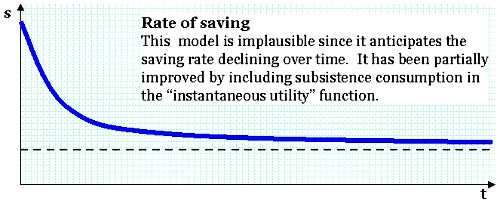
In the graph above, the economy responds with a reduction in consumption, and concomitant increase in saving. Richer models incorporate a "floor" of consumption that causes it to start low, and rise to overshoot the higher balanced growth path (BGP) savings rate.


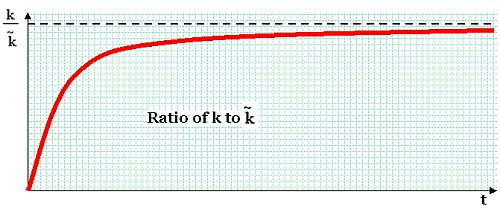
Here, the economy's stock of capital is converging. Notice that the high saving rate is accompanied by a steep slope for k; high values of s amount to exactly the same thing as high values of . Likewise, in our simplified model, the efforts of households to maximize consumption over infinite time horizons leads to rapid accumulation.

This is the big picture: the balanced growth curve, in which the endogenous factors are growing at a constant pace (dotted line) while the equilibrium growth path gradually catches up.

(Part 3)
____________________________________________
Notes

1 Time discounting: it is usually assumed that humans generally prefer consumption in the present to consumption in the future. As a result, we assume humans have to pay more to consume now than they do if they wait.  Discounting is a way of expressing this preference in the form of a low price for future consumption.

As always, special exceptions may apply but remember, economists tend to be interested in average or median behavior. Even if exceptions are very common, therefore, people with unusual time-of-consumption preferences can demand the same discount as everyone else.

Typically, for purposes of government accounting the Office of Management and Budget (OMB) uses a rate of 7%, and tests for rates of 5%-9%.
____________________________________________
Resources and Additional Reading:

The Ramsey-Cass-Koopmans model is explained formally here (and here), for those of you interested in a backup source. The first link is to the site of Prof. Thomas M. Steger in Zurich; in my opinion, his explanation is not only the best I've seen online (and the most reliable), it's also better than the one in David Romer's textbook Advanced Macroeconomics (1st edition), which is the one I was initially using. Juan Ruiz, a Spanish economist, posted lecture notes on the RCK model that are also very easy to follow.

For a detailed introduction to production functions, see Egwald Economics;

Labels: , , , , , ,

12 December 2005

Some thoughts on Game Theory & Economics

Readers will probably be familiar already with the fundamental economic notions of supply and demand, of diminishing marginal utility/productivity, and so on. I'm hoping readers understand the mutual compatibility of free will and the "laws" of economics, also. John Ruskin, in Unto this Last (1862) complained that economics had no room for meritorious or selfless motives; there was no room for solidarity between employers and laborers, for example.
Among the delusions which at different periods have possessed themselves of the minds of large masses of the human race, perhaps the most curious—certainly the least creditable—is the modern soi-disant science of political economy, based on the idea that an advantageous code of social action may be determined irrespectively of the influence of social affection.
However, Ruskin's understanding was imperfect: non-economic, or counter-economic, motives (such as emotional affinity for one's employees) are not incompatible with the concept of labor markets per se; rather, such motives tend to average out. For example, if someone boycotts Starbucks, others may just as likely develop "consumer loyalty" to the same firm, or a "social affection" to the staff of a particular franchise. Nor is Ruskin's objection convincing in regards to the labor market: if some firm out there, such as Old Fezziwig's, pays its workers more than it absolutely must to prevent their starvation or flight, then this reduces the number of persons Old Fezziwig may employ, thus pushing the general level of wages down by a very slight amount.

(There are other problems with classical economics, but Ruskin doesn't really know what they are.)

Economics needs to be understood not as a deterministic prediction of how persons will behave given the prices of stuff they like, but rather, as an explanation of the tradeoffs they make. Assuming a population has a reliable set of moral virtues, for instance (like a desire to avoid polluting the environment) at a reliable concentration, a decline in the price of gasoline will still result in an increase in gasoline consumption. That's because people, however much they may dislike consuming petrol, will find a dollar spent on it to provide more utility than it did before. And even if a few diehards are determined to buy absolutely positively no more than x liters of the stuff per week, no matter what, this means that enterprises using it will still be able to buy more; indeed, if a choice exists, they might increase, say, passengers transported, by leasing more cars as cabs or express vans.

However, at the level of business institutions (including, for example, labor unions, banks, and governing bodies in the national economy), economics can make few meaningful predictions. True, the average firm will (over the greatest possible time horizon) expand production until marginal costs equal marginal revenue; but there are many reasons why a particular firm, during a particular period of operation, will not. One reason is that the firm may be a specialty producer of things like ocean-going vessels or large buildings; its production levels may be controlled entirely by the local demand for a highly-specialized product. There is no meaningful demand curve for such a business, since, even if it could cut costs and prices by two-thirds, the industry for which it produces could only consume the same number of hydrocracker units or tower cranes.

Another reason is strategic-temporal. Most firms cannot just increase output by whatever amount they need to reach MC=MR. If you are the manager of a semiconductor fabrication firm, for example, you many want to increase output by 31.5%, but a new facility will increase output by 65%. If you stay where you are, marginal costs may be quite different from marginal revenues; but if if you get the new facility, you'll be working with an entirely new set of cost and revenue curves. Even if you have reached a point where the advantages of such an expansion are totally certain, you may wish to wait until the industrial union has negotiated a new contract before announcing the new plant.

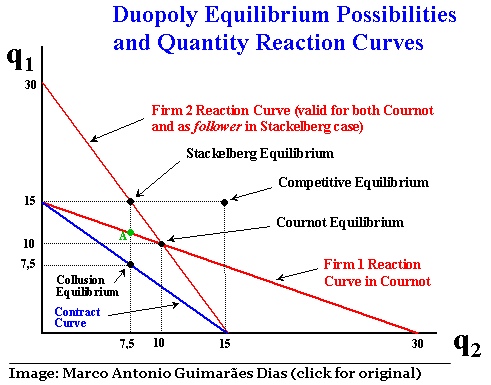
Other reasons—presumably the best-known reason—has to do with solutions of the duopoly problem. If you have only two big firms that sell a product, both will want to reach MC=MR; MR varies with the sales of the firm, so both duopolies and monopolies enjoy higher marginal revenue if sales are held artificially low. Unfortunately for the manager of the duopoly, the other firm wants you to reduce sales so it can reap the higher marginal revenue, while you will want to do the same.


A mathematician, Antoine Augustin Cournot (1801-1877), proposed that game theory offered the solution to what duopolies would sell. He used this to extrapolate the linkage between game theory (which supplied the optimal choices for individual actors) and economics (which anticipated the behavior of vast numbers of actors).

Game theory was an exotic concept for economists until the 1950's. In 1951, mathematician John Nash introduced the Nash Equilibrium (actually, the mathematical explication); then John Harsyani introduced ('58) the concept of Bayesian approaches to a Nash Equilibrium. The tremendous analytical opportunities opened by game theory and the digital computer transformed economics, as theorists sought to meld the study of individual behavior and the behavior of entire economies, to achieve something that had far more predictive power. By the 1960's, Carnegie Mellon University professor John Muth had introduced the concept of "rational expectations," which sought to represent the economy as a scalar multiple of average actors; this idea was examined in far greater detail by Edward Prescott, who also tried to restore neoclassical economics. In effect, the new economists of the 1970's expanded microeconomic analysis to cover the behavior of the entire national economy.

The evolution of game theory and economics continued to drive most research, ultimately superceding "rational expectations." Adherents of the new classical economics, after the mid-90's, tended to downplay "rational expectations" in favor of "stochasticity" and "dynamic general equilibrium" (DGE) analysis [*]. At the same time, the new Keynesian model has incorporated both DGE and stochasticity, although since it does not believe policy is ineffective, it retains the ideological rift with the likes of Prescott, et al. However, like the new classical models, there is an element of expectation. As it happens, the role of expectations applies to prices and wages, as well as to expectations of future interest rates and inflation, so the New Keynesians could retain the old concept of sticky prices (and hence, adjustment of the economy to equilibrium via quantities, rather than fluid prices).

WHO WINS THE "GAME"? NEW CLASSICAL? OR NEW KEYNESIAN?
("New classical" is an economic analysis that emerged after 1961 and became prevalent in the USA after 1978; "neoclassical" is a synthesis of "marginalism" and emerging understanding of monopoloid markets, etc.; it became prevalent from 1890 to 1936)
The impact of game theory on economics can push it in different directions. As understood by the likes of Oskar Morgenstern, Robert Barro, and Vernon Smith, game theory was employed to make the case that monetary policy would be thwarted by financial arbitrage, while social welfare programs tended to expose economically virtuous actors to blackmail by economically weak ones.
(The "economic loser" theory, in which a socially-optimal technology is blocked by an economic class whose rents are threatened by it, is discussed and refuted in this PDF file by Acemoglu & Robinson)

From the other direction, Matthew McCartey points out that the interconnectedness of behavior under game theory assures multiple equilibria—leaving the state with the obligation to ensure the one that prevails is one corresponding to social goals. Likewise, Anatol Rapoport, noted game theorist, repeatedly treated confrontation as an institution in and of itself, which guided the formation of confrontation-promoting institutions. Cooper & John, in "Coordinating Coordination Failures in Keynesian Models" (PDF-1988), which introduced the concept of "strategic complementarity" to explain involuntary unemployment. As McCartney notes, these theories place an extraordinary burden of rationality on the individual, as well as on the individuals' self-knowledge. In the face of life experience demonstrating that most individuals lack either rationality or the opportunity to make predictions that average to accuracy, both justify their assumptions by anticipating that some economic agent will identify arbitrage opportunities and capitalize on them.

But even the notion of arbitrage does not save the rational expectation. That's because a prediction only becomes an arbitrage opportunity when discovery (i.e., the event happening) proves the prediction true or false. An example is the commodity options market. We can assume the options market for crude oil captures all available information for predicting the spot price of oil on 1 June 2006. But when 6/01/06 rolls around, the inferred price (i.e., the price for which the 6-month option price-spread was most advantageous) will probably be wrong, and the fact that a lucky few will have got it right contributes nothing to technical efficiency in the oil industry. A more compelling example is the impact of Volcker's monetary supply growth targeting in 1980, which could easily have been foreseen, but was not.

However, game theory is valuable when we are trying to assess reaction to uncertainty. Moreover, as with economic theory generally, game theory is far more useful examining why institutions fail to achieve desired results. Both are effective as instruments of analysis; they are dubious as elements in positive science. Hence, the typical confusion of critics: physics allows people to make moon landings, while economics offers an ingenious tool for defending absolutely any course of action. Neither it nor game theory can be falsified by observation, whereas physics can be. The flaw in this reasoning is, of course, that while social sciences are necessary, they are quasi-legalistic: whereas a physicist or chemist is productive regardless of anyone else understanding physics or chemistry, an economist is useful only in a population of other economists. The same may be said of lawyers; a single lawyer, entrusted with unilateral power to make decisions, is not particularly likely to make good ones, and lawyers are constantly disagreeing with one another, yet (I speak in compete seriousness), a nation without lawyers is virtually ungovernable. Again, one requires a structure run by legally-trained people to administer law; but there is no such thing as a controlled experiment for ensuring a legal decision is correct.

The ability of an economist to supply useful information about system failure stems from the techniques of analysis and scrutiny that economics has developed; the ability to compare rival historical forces (such as, rising supply and rising demand for a good, which have contradictory effects on price) and establish which one is more important, the ability to render disimilar situations into comparable ones for purposes of relevant comparison, and the ability to use mathematical models to test assumptions for absurdity, are the implements that economics brings to the social sciences. Game theory does the same thing, albeit more starkly.

New-classical economists will not take well to my previous two paragraphs. A few might nod in agreement, then insist that economics is good at identifying costly frictions (such as rent control or minimum wage rates) that can prevent full employment; but beyond that, they'd have a hard time explaining why economics had anything to say after Jean-Baptiste Say and Frederic Bastiat died. The Keynesian, in contrast, would wonder where the IS-LM curve fits into "supply[ing] useful information about system failure." Economists observing the economic implosion of the late 1920's, from '37 onward largely agreed the failure of sustaining adequate demand was responsible for the calamity, and devised various proposals to defend future demand. I would observe that, when economists began conceiving social welfare programs to ensure minimal levels of demand and institutions to prevent global financial illiquidity, they were doing their jobs successfully. But when, having developed institutions to prevent fiscal and monetary failure, they assumed those institutions would always work, they made profound errors in their own field that led to another, albeit much smaller, economic crisis in the 1970's.

The crisis was caused by the economics furnishing, as they evidently surmised, an instrument to solve the problem of the business cycle. It was so powerful its use became addictive. Yet the economists largely overlook the dangers of overuse. They failed to see how the tool could be insidious. And when at last its restorative powers were exhausted, the entire profession simply recanted fiscal and monetary policy, en bloc. Since economists did not offer alternative tools to political leaders (who demanded them), the result was that quasi-automatic fiscal policy and discretionary monetary policy continued to operate.

Today game theory is moving towards offering a meta-theory, or theory about theories. The question is no longer, what is the most appropriate judgment in any particular scenario (from the perspective of an omnipotent authority), but rather, what determines how a decision will be made? Instead of announcing the optimal decision under uncertainty, there is more interest in understanding what sorts approaches will be used, and if they are strategically different. The new field of neuroeconomics seeks to adapt to utility theory without rationality. Such a version of economics, in which actors operate in a system/institution, constrained neurologically, and limited to strategic behavior under uncertainty, would leave us about as far from classical economics as it is possible to get.

UPDATE (27 January 2006): Luka Crnic (Cherishing the Mundane) posts on the "hot topic" of neuro-economics. He begins with an article in The Economist:

No longer will economists rely on crude statistical models of how people behave in response to a policy change, such as an interest-rate rise or a tax increase. Instead, they will be able to peer directly into the brain to predict behaviour.
Here, neuro-economics is used as a research tool in "behavioral economics," i.e., the study of economic decisions made by individual actors. The original study of behavioral economics employed the familiar scheme of translating the researcher's individual hypothesis about economic behavior into a constrained optimization problem, then "modeling" economic events as if the nation consisted of 300 million identical humans. It was obviously a simplification, but it could be used to screen out categorically absurd scenarios. It was Quasi-Rational Economics, by Richard Thaler and Hersh Shefrin, and it introduced such compelling ideas as the split personality ("planner-doer"). Those interested in an introduction to behavioral economics can read "Behavioral Economics" (PDF) by Sendhil Mullainathan & Richard Thaler.
My impression is that further refinements in understanding of economic behavior at the personal level would only lead to a tweaking of the constant relative risk aversion component of utility maximization functions.

In "Social Neuroscience and Neuroeconomics," Crnic outlines some of the actual research in neuro-economics, which does indeed include fMRI scans of people playing a game.

First of all, what role does caudate nucleus play?
[Nature Neuroscience paper]: The human striatum has been implicated as a critical structure in trial-and-error feedback processing and reward learning. In particular, the caudate nucleus, a structure linked to learning and memory in both animals and humans has been shown to have a role in processing affective feedback with responses in this region varying according to properties such as valence and magnitude. It has been shown that activation in the human caudate nucleus is modulated as a function of trial-and-error learning with feedback.
This clearly indicates that the perception of the moral character of the partner in the trust game directly influences the neural mechanisms connected with feedback processing in trial-and-error learning
The next day, in "The Consilience of Brain and Decision," Crnic reviews a paper of the same title; he outlines some of the practical principles, without spelling out how this might affect economic modeling or analysis. I really need to return to these posts and others of Crnic to understand them properly, especially since there are so many links I will need to read.

(cross-posted at Hobson's Choice)

NOTES:
Rationality: strictly defined in economics:
  1. [Transitivity] If a decision maker prefers A to B and prefers B to C, then she should prefer A to C;

  2. [Completeness] A decision maker is rational if she can rank all bundles of goods. If two bundles have equal rank, then that is a valid rank and the decision maker is "indifferent" to them
Some add some other attributes, such as monotonicity (i.e., if you like A more than B, then 2xA will be better than 2xB), local non-satiation (i.e., if A is a thing you like, then 2xA is better than 1xA), continuity, convexity (meaning, the marginal rate of substitution of A for B will increase as one's supply of A increases, however slightly) etc.

ADDITIONAL READING: Marco Antonio Guimarães Dias, "Asymmetrical Duopoly under Uncertainty: the Extended Joaquin & Buttler Model," Pontifica Universidade Católica, Rio de Janeiro, Brazil

Labels: , , , ,