23 January 2007

Flickr Geotags

Flickr is a website that offers free hosting of digital photos. There are some fairly important restrictions on the size of the files that one is allowed to post to flickr without a pro account; for example, nothing over 500 pixels in any direction. Still, Flickr is an amazing website and it offers an amazing amount of value, especially for bloggers (the fact is that, for blogs, there's very seldom any need for bigger photos).

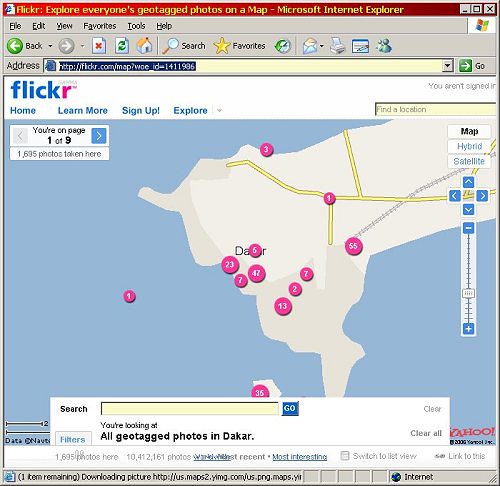
One of my habits is to find photos of things my wife is interested in and email them to her. Today it was photos of Dakar, Senegal. But I noticed that Flickr was showing off a new feature, called "geotags." Basically, you search for a location and Geotag displays the map, with photos of the relevant geographical tag.


Incidentally, to get to the screen displayed, just click the image...

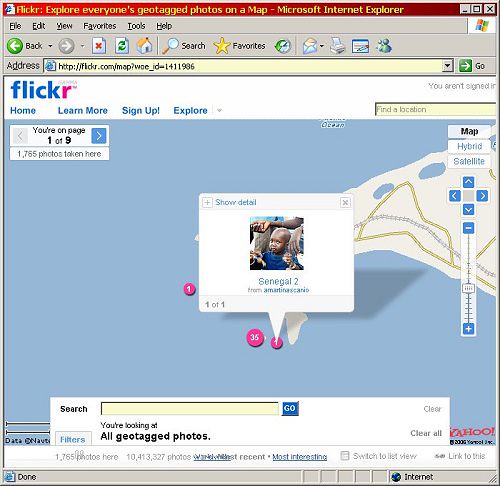
You can select one of the magenta dots to show the photo[s] with that location tag..


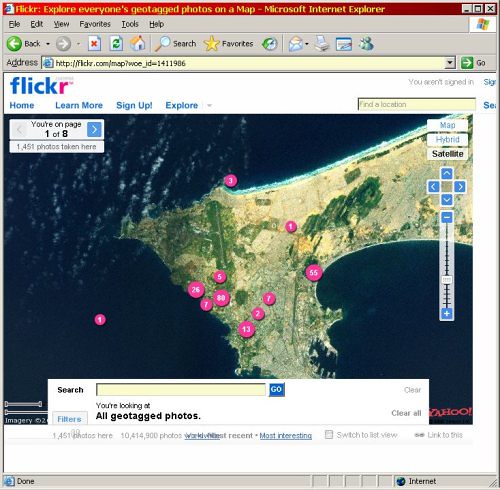
And you can view the area as a satellite photo.


That's for those of you who perhaps have become blasé about Google Earth.

Labels:

23 October 2006

Content Management Software

Content Management Software (CMS) is a broad category for software; it's used to organize and arrange the data files used in media of various kinds, such as online news sites, blogs, wikis, and so on. That's a pretty large subject, and those with a vocational interest in CMS applications are likely to discover that the huge range of CMS products reflects a huge range of CMS markets, with incomparable subdivisions.


CMS applications are usually very closely related to database management software; it has a backend that consists of content being managed, and a frontend that consists of the query (search) feature, display feature, or reporting feature. Hereafter, I'll be referring to the back end as the "content management application" (CMA) and to the front end as the "content delivery application (CDA)."

Not all CMS apps fit into the database format, though; for example, Movable Type and PmWiki are two common file-based applications.1 Movable Type is a very popular blogging software which users install on their personal webhost; PmWiki is a WikiEngine that users can install on their host for the creation of stand-alone wikis. In a file-based CMS, the software generates a new static page, which hereafter has a permanent address of its own.

Both file-based and database-oriented CMS apps have their virtues. The big advantage of the database design is that it is really suited to sites with immense numbers of entries. For example, while I don't know for certain, I strongly suspect that Blogger (this site) has over a 10 million individual posts. Often I have links to a particular post, which then appears as a stand-alone page. One can also pull up all my entries for the month of August 2005. In Movable Type, where I have another blog, one may also pull up posts organized by category. I naturally had an interest in including each post in as many topic categories as possible. My host was quickly maxed out because Movable Type would accomplish this by making a separate page for each way of organizing posts, which meant each post had to be stored many times; moreover, a static page has to include all of the junk on the side, the logo at the top, and the Perl scripts for comments. If Blogger worked that way, the site would be impossibly expensive to run. Instead, the blog engine (frontend) actually generates a page from fields in a vast table. Of of the columns of that table includes the text you are reading right now. Another column includes the date, while another includes settings I selected, like "allow reader comments."

File-based software has the advantage that hosting is simpler. If there are relatively few pages in the site (under a thousand), it's not a serious problem if every page the visitor could see is its own permanent file. The hosting software is simpler, and backups or modifications are easier.2

Features of CMS typically include CSS and XML, which determine the appearance of all pages without the user having to laboriously enter the HTML for each page. So, for example, the CSS for Blogger ensures that, unless I specify otherwise in an HTML tag, all text will be in Georgia font, and the background will be a certain color.
___________________________________________________________
1 "Movable Type vs. ExpressionEngine — A comparison," François Nonnenmacher, 2004; WikiMatrix-Compare Them table.

2 WikiMatrix--Compare Them All. I actually think modifications of the file templates are much easier if you've got a database CMS. Movable Type has templates that can be modified with a minimal knowledge of Perl, but editing the contents of each page requires that you individually visit each page and change it. In a database CMS, it's possible to access all page content through the page content table. You can insert fields and have those fields updated en masse whenever the data that belongs in it is updated.

Another important feature that I appreciate about database CMS designs is that archiving is totally flexible. Using Movable Type again--it can organize archived posts by month, week, topic, and individual; but it has to have a permanent file for each. If you create a post filed under multiple topics, then your host has to store many copies of the exact same HTML. That's absurd. In contrast, Blogger (which is not a stand-alone CMS) can simply create an entirely new archive just by entering a search query. Of course, Blogger's busy servers don't save anything--they just upload the archive to your Temp file, just like anything else you download.
___________________________________________________________

SOURCES & ADDITIONAL READING: "Content Management System," Whatis.com; "Content Management Software," Wikipedia; Overview of (web) content management systems, CMS Matrix (and links off that list);

Labels: ,

10 April 2008

What is coltan and what does it have to do with my cell phone?

UPDATE (11 Feb 2014): This article has been substantially revised since initial posting.


"Coltan" is short for columbite-tantalite, a mineral from which niobium (AKA columbium) and tantalum are extracted.  It's a mineral found mainly in Nigeria, Rwanda, Mozambique, Malawi, and Congo-Kinshasa (Democratic Republic of Congo). "Tantalite" is the usual internationally-used name for this mineral, which--depending on the grade--carries different concentrations of either tantalum or niobium.

About Tantalum

Niobium is usually used in the production of high-strength steel alloys, not semiconductors; tantalum is used in the production of cell phones because, as a superconductor, it sharply reduces the amount electricity required.1 Superalloys account for about a fifth of consumption. Tantalum has an extremely high melting point, 3017° C, and is an excellent conductor.2  It can be made extremely strong for cutting tools, resists corrosion, and can be used to make surface acoustic wave (SAW) filters used in cell phones, etc.  In cell phones it is also used in capacitors and the lenses of cameras.

The Supply

Not all, or even an especially large proportion, of tantalum/niobium comes from Africa; most comes from Australia or South America, and much comes from minerals other than tantalite; however, tantalite is one of the more important ones, commercially (often any commercially significant tantalum-bearing mineral is called "tantalite.")3
Cell Phone Recycling Guide: The legacy of "blood diamonds" is well known, however the fact that a similar arrangement exists to mine coltan (Columbium Tantalum) is lesser known. Tantalum is a superconductor, one of the best on Earth. It is used to coat capacitors to help them create more power from less energy so that your cell phone no longer needs a battery larger than the phone itself. In war torn central Africa, people are forced into modern day slavery to mine this rare element, which is then sold to fund the wars in this region. Recently the majority of Tantalum production has shifted to Australia, however it is a rare element, so decreasing demand helps decrease the likelihood that manufacturers will turn to African supplies.
A lot of the moral headaches associated with African tantalite arise from "artisanal mining" (artisanal & small scale mining, or ASM) only a part of which comes from areas controlled by warring militia from Congo-Kinshasa (Democratic Republic of the Congo).  One of the features of the Dodd-Frank Act was a provision requiring companies reporting to the Securities Exchange Commission (SEC) to say whether or not the tantalum they bought came from the conflict region.4
Tantalum Market Overview: A major problem with the whole issue of conflict tantalum is the ability to track tantalum back through several stages to its original source. A key element of this is the concept of “bag and tag”, which essentially means identifying tantalum ore at the source of production and providing the means to track it down the chain.
The industry itself has introduced several schemes to address this. One is the Conflict-Free Smelter (CFS) Program, which was developed by the electronics industry to eradicate unethical sources of raw materials from the supply chain. Driven by the Electronics Industry Citizenship Coalition (EICC) and Global e-Sustainability Initiative (GeSI), the CFS Program is being adopted by the automotive, aerospace and other metal-consuming industries and a growing number of tantalum smelters are now certified as conflict-free.
Since originally posting this essay, the locus of concern about "conflict exotics" (i.e, artisanal mining of exotic metals and strategic materials in warzones, usually under duress) has shifted from the DRC to the Central African Republic (CAR).

Notes
  1. "Niobium: Market Outlook"; "Tantalum: Market Outlook," Roskill (accessed 11 Feb 2014)

  2. "Tantalum Market Overview," Minor Metals Trade Association (accessed 11 Feb 2014).  The MMTA report mentions:
    For most of the 2000s it was often reported that the majority of the world’s tantalum resources were located in Central Africa and in the Democratic Republic of Congo (DRC) in particular. Towards the end of the decade, however, the Tantalum-Niobium International Study Center, the industry’s principal forum, estimated that some 40% of the most likely global resource base is in Brazil and elsewhere in South America, followed by Australia, with 21%. Central Africa was estimated to account for less than 10%.
    Is this true, or was "artisanally mined" tantalum accounted for as contribution from Brazil?

  3. Tantalum - Raw Materials and Processing," from website for Tantalum-Niobium International Study (TIS) Center (Lasne, Belgium--accessed 11 Feb 2014). A major development since originally posting this article was the collapse of demand/prices and some national suppliers in 2009-2012.  

  4. See Ken Matthysen & Iain Clarkson, "Gold and diamonds in the Central African Republic: the country’s mining sector, and related social, economic and environmental issues" , ActionAid Nederland and Cordaid (Feb 2013), p.11, for the Dodd-Frank Act disclosure requirements re: tin, tungsten, tantalum, and gold.

Sources & Additional Reading

"Cell Phone Recycling Guide," Phone Scoop blog (via Textually blog, 19 Jan 2005)


John F. Papp, "Mineral resource of the month: Niobium (Columbium)" (December 2007 accessed 11 Feb 2014); and Larry D. Cunningham, "Mineral Resource of the Month: Tantalum" (August 2004), both from GeoTimes blog. Both discuss the applications for the materials (including substitutes).


"Columbium (Niobium) and Tantalum" , Larry D. Cunningham, USGS (1999)


ADDED 13 Nov: "Mobile phones link to bloody Congo conflict" (Independent.ie, 9 Nov 2008)

Labels: , , ,