
06 January 2007

The Dynamics of Industrial Choice (1)

Often, economic models seek to explain business decisions based on a snapshot of conditions. Hence, we have the case of the indifference curve and the production curve. Both are closely analogous:

INDIFFERENCE CURVE

In economics, one speaks of "utility" as a state that cannot be measured, but can be compared; so, for example, in the chart below, the blue line (U1) represents a lower lever level of utility than the red (U2). It is not valid to say U2 represents 1.5x as much utility, but we can include a very large number of intermediate levels of utility between the two points.
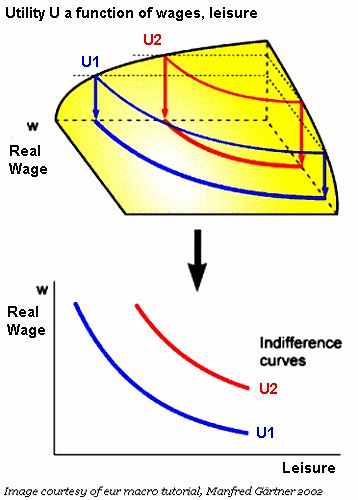


Utility is always described as a function of two sources, such as "wages" and "leisure" (from the POV of the worker). Of course, if you increase wages without reducing leisure, or increase both, then the person obviously has a higher level of utility. But what about when one must trade one for the other?
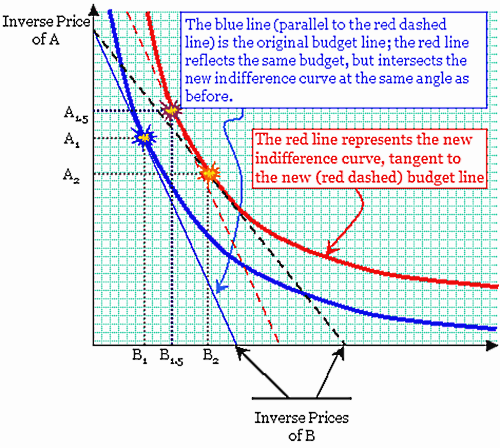


In the graph above, the economic actor's utility is a function of A and B. The red line is the result of a sudden decline in the price of B. When that happened, the "budget line"—the straight dashed lines slicing diagonally across the graph—moved outward, to the right. That diagonal line intersects the A-axis at the point where the consumer spends 100% of her income on A, and the B-axis where she spends 100% of her income on B. So when the price of B fell, the budget line moved outward to intersect with a new, higher, level of utility.

When the consumer had the lower (blue) budget line, she consumed A1 and B1. When the price of B fell, her consumption of both increased, to A2 and B2. But economists make a distinction between (A2, B2) and (A1.5, B1.5). While some of the change in consumption (ΔA,ΔB) can be explained by the increased income—i.e., the new, "purple" flashpoint on the red curve above—some of (ΔA,ΔB) is the result of substitution. So, for example, the increased real income caused by a decline in the price of B actually caused the consumption of A to decline in absolute terms. An income effect will always cause both to increase, but a substitution effect will always cause consumption of one to fall relative to the other.


OUTPUT CURVE

This is closely analogous to the indifference curve, and so I used a similar graphic with different labels (the original graphic is here).
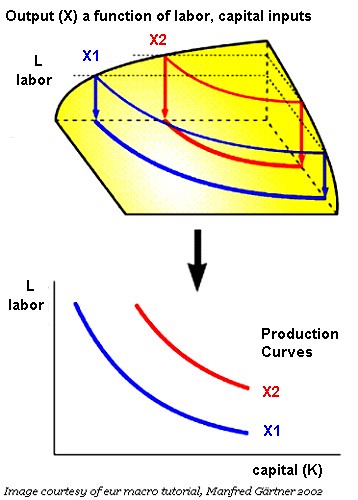


Here, the tradeoff is between labor (L) and capital (K), or any other combination of inputs. While I've shown only two inputs in the diagram, it's possible to set up optimization equations involving as many inputs as you like... such as different capital structures (bonds versus bank loans versus equity), energy inputs, and so forth. One element that is new to the production curve here is the idea of technology: the possibility that output (X) can increase without an increase in L or K. In fact, economists simply treat technology as another input (A), and have long debated the role it plays (here's a formal treatment).

The concept of the indifference curve in economics dates back to the 1870's; some of the first economists to use it were the "Marginalists," such as William Stanley Jevons (1871) and Leon Walras (1874). A formal explanation of these concepts may be found here.


PARETO OPTIMIZATION

Pareto Optimization is illustrated by the Edgeworth Box shown below. It's really just a pair of indifference curves. One thing to remember is that, while the vertical axis shows rising wages, the direction of the horizontal axis is reversed. That's because the "zero" axis for the utility of the owner of capital is in the extreme upper right-hand corner of the graph.
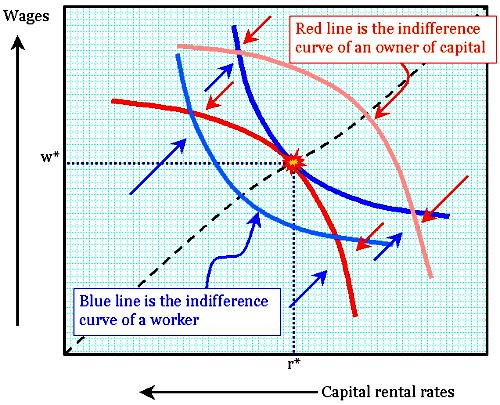


According to this chart, the rising rate of wages is one contributor to the utility of the worker; another contribution is lower interest rates (or capital rental rates). The latter effectively increases the purchasing power of the worker.

(Incidentally, this is not a radical or leftist conception of labor-capital relations. It's from the work of Francis Ysidro Edgeworth and Vilfredo Pareto, two of the most conservative, orthodox economists who ever lived. Anyone who is seriously disturbed by my dichotomy can relax. Everyone agrees that there's a missing dimension here, which is that of time. A reasonably high value of r leads to an increase in the accumulation of capital, allowing for greater total output.)

The object of this diagram was to illustrate how the market, under optimal conditions, resolves the controversy of the correct distribution of the total economic output between labor and capital. This same dichotomy of interest also exists between producers and suppliers, or taxpayers and the state.

However, the chart also illustrates something else: one can see here the idea of demand reaching a convergence with available output. The optimal solution is one where the rate of indifference is the same as the comparative cost, which is (in turn) determined by the output function.

(Part 2)

Labels: , , , , ,

26 September 2006

Concepts of Efficiency

An important criterion of technology is that it allows for a more efficient version of the productive process. But what is efficiency? There are several conflicting definitions of this term.

Technical Efficiency:
This is the most straight forward definition of efficiency, and it boils down to carrying out the same task with the fewest resources. The application of the term becomes controversial over what defines "same task." Still, technical efficiency is usually the one variety of efficiency that is directly and empirically measurable. A more efficient gas turbine generates more work per unit of fuel consumed; a more efficient refining process requires fewer of at least some inputs, per unit of useful output.

Another term from economic usage is X-efficiency. X-efficiency is the degree of inefficiency in the use of resources within the firm: it measures the extent to which the firm fails to realize its productive potential. For a given set of inputs, productive potential is identified with the point on the production possibilities frontier. X-efficiency arises either because the firm's resources are used in the wrong way or because they are wasted, i.e., not used at all.1

Economic Efficiency:
This refers to the ability of an economic or industrial system to provide what consumers what, given their incomes. This is an idea that is almost unmanageably ambiguous, since "efficiency" implies a comparative virtue, and it is difficult to see how one could make a meaningful comparison between two economic regimes with competing claims to superior economic efficiency.

An immense amount of research into comparative health care systems has attempted to compare their relative economic efficiency, but usually founders on the definitional proviso, "given the consumers' incomes." All health care regimes (and, incidentally, nearly all aspects of all industrial systems), not just "socialized" ones, involve substantial transfers of costs based on the judgment of responsible institutions. In the United States, one form of transfer is between insured and uninsured patients; the latter are charged far more for identical service, but often default on payment.

Setting these stumbling blocks aside, the idea is helpful for understanding the goals of policymakers and designers: consumers want bundles of goods that vary depending on institutional choices of technology. For example, in the 1980's nearly all gas stations in my home state of California became self-service. Obviously, a large number of consumers had preferred full-service; on the other hand, it allowed gasoline vendors to reduce overhead, keep stations open longer hours, and keep stations in areas where the traffic was comparatively lower. As stations turned into petrol vending machines, price increases were somewhat mitigated, and consumers now had access to petrol 16-24 hours a day in the new suburban sprawls. Was the exchange an improvement? It seems highly probable that it was; if consumers had en masse felt otherwise, at least some full-service stations would be found in large, elegant neighborhoods. The self-service filling station was a technology that had to compete with the once-prevailing full-service station. Some consumers complained, but they voted with their dollars and their steering wheels.

I am pretty sure there is no plausible scenario of free choice in which people would chose MS Internet Explorer as their web browser, if an actual market prevailed for software.

Pareto Efficiency:
(Main essay on Pareto Optimization)
This is a more refined notion of economic efficiency. It is the condition where no one may be made better off without making someone else worse off. Put another way, all possible benefits from an economic system have been captured for the participants. Distribution may be very unfair, but it is not wasteful. There is no wasting of potential output due to disuse of labor or capital.

Distributional Efficiency:
This concept is highly dependent on the context. In many cases, distributional efficiency refers to the ability of an institution at distributing benefits to its intended beneficiaries. An example that springs to mind is the design of a very large housing development. Often the designers want to include benefits like WiF in the apartment complex, to make it attractive to renters.
Forever Geek (via Philobiblion): The end result? Residents with laptops can sit down beside the river and work or play online in a calm, scenic outdoor setting, with the same high speed access they have in their apartments. Residents aren’t stuck with dialup, and fixed income residents can now experience the Internet for free, a feature they very much appreciate. They can video conference with their grandchildren and research anything that strikes their fancy, at speeds averaging 4-5 times dialup in busy times.

It’s working very nicely, and the complex is full. Other units that have vacated have been filled, with the final selling point often being the free broadband. And the website has brought in a good number of residents and lots of inquiries about future openings.
This was a success, but other benefits of this nature are a disaster. The most common failures are events, like parties, in which the resident fees pay for a party. Another is the useless park, described here with illustration. Incidentally, in my part of the country (Washington) these "pods" are endemic, and presumably part of the hermetic philosophy of zoning laws in our society. There's several along my preferred evening stroll, and they're usually empty. Strange, because it's late summer and the weather is extremely pleasant. My point is that the design of either building codes or of development layouts have failed to consider distributional efficiency properly. Instead of successfully distributing the utility (goodness, usefulness, pleasure, fun) of the common areas, these developments have wasted about half a million apiece on land that no one uses. Residents drive past the pods, often with their children in the car—whisked off to the mall.

Another, more urgent matter, has to do with the distribution of scarce natural resources in a way that maximizes the utility to society. The most obvious example of this is water. Typically, in many 3rd world countries, water is monopolized by large landowners, who then sell it at a premium to politically allied small farmers, or to industries that avail themselves of the cheap water and opportunities to pollute. Another serious problem is the effect of pollution on water distribution. Usually 3rd world countries are popular as industrial locations (for re-export to the West) not so much because of the cheap labor, but the easy access to cheap water as a pollution receptacle. Historically, national governments are very favorable to mixed-use developments like the gigantic plantation-cum-pulp mill.2

These are examples of distributional efficiency that arise within a [nominal] market economy. In the case of the development, zoning laws mandated those useless "child pods" but then the clientèle of the estate demands insulation from children. In the case of a typical 3rd world rural economy, there is a strong tendency for property rights to be unevenly enforced, so that the country's nascent industrial system "exports" grossly under-priced water (as a pollution receptacle), the landlord collects rents in foreign currency at absurd terms of trade, and the paysannerie suffers a perpetual thirst. Capital accumulation doesn't occur, and the country[side] falls further and further behind the industrialized West.

A misguided objection to the concept of distributional efficiency is that such considerations support forcible redistribution of income. But it's not just college professors pondering issues of social justice that care about distributional efficiency; private corporations that provide services to a paying clientèle have to worry about the stuff they furnish to customers to satisfy them, like swimming pools and gyms in hotels. Most government regulations exist to protect property rights; how does one award property rights in natural resources fairly? Even the most devout libertarians have disputes about this when they are compelled to deal with this in real life.


NOTES:

1 Mark Casson, The Entrepreneur: An Economic Theory, Rowman & Littlefield (1982), p.364

2 gigantic plantation-cum-pulp mill: Chapter One of Death Without Weeping (Nancy Scheper-Hughes, 1993) dealt very effectively with the social impact of a huge industrialized sugar plantation.

SOURCES & ADDITIONAL READING

John Vidal, "Cost of Water Shortage: Civil Unrest, Mass Migration and Economic Collapse," Guardian Unlimited (2006);

Pallavai Aiyar, " Water woes," Frontline-India (2007);
Chandra Bhushan, editor "Not a Non-Issue," CSE India (2004)


SEE ALSO: The Expert's Dilemma—

Labels: , , , ,